
Edited by Consuleria Published
Define what you want to check
Place, period, origin of the publication and content of the scene are different questions. Choose one and describe the limits of the material: original image or copy, crop, resolution and provenance. If the question concerns a controversy or data of people, evaluate first the scope and conditions of the activity.
Annotate observable elements
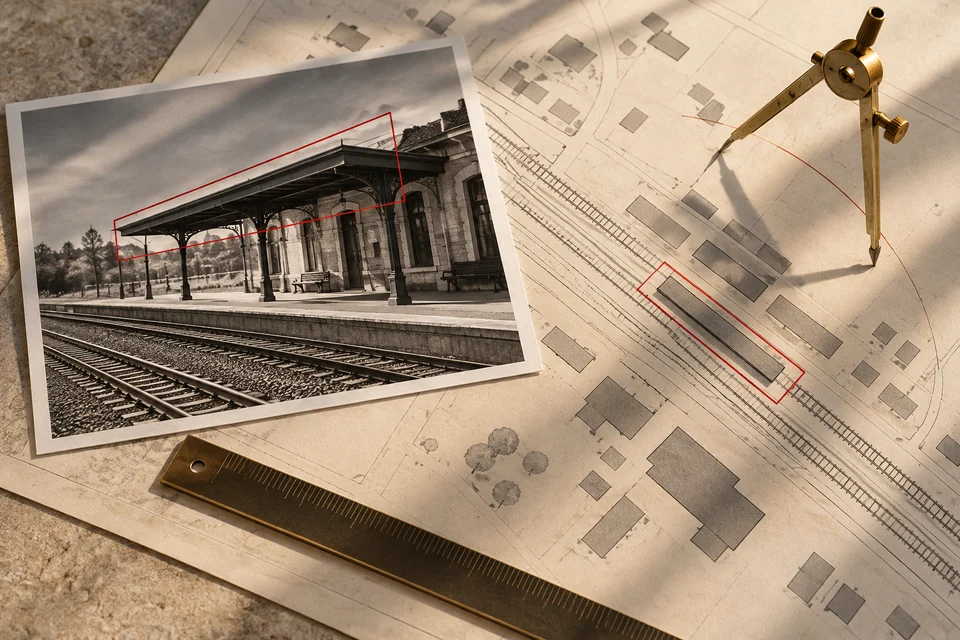
Roads, buildings, findings and signage can provide clues. Transcribe what is actually visible by separating it from interpretations. “Building with tower next to a square” is an observation; the name of a city is already a hypothesis. The distinction makes it easier to correct the path when an incompatible element emerges.
Comparing independent sources
Reverse search can identify other publications, while maps and spatial images allow comparisons. Check if the results are from one source and if the dates are those of the content or only of the publication. A partial match should be tested with elements that might disprove it, not only with those that seem to confirm it.
Use geometry and time with caution
Shadow orientation can only help to evaluate a hypothesis if position, scene orientation and conditions are sufficiently known. Solar instruments do not determine the date of a photograph on their own. Perspective, surface, distortions and off-field objects can alter reading.
AI as a suggestion, not attribution
An assisted geolocation system can propose plausible places and make convincing mistakes. Check each proposal through external corroborating evidence. Do not upload confidential photographs or personal data to external services without evaluating conditions and permissions. To practice, choose synthetic images or material that you can legitimately have.
Keeping a Chain of Reasoning
Record question, sources consulted, access dates, compatible elements, contradictions and level of confidence. A useful result can be a probable area or the absence of sufficient elements. In the Hub you find tools and schemes to explore these steps; in the consultancy they are selected in relation to the concrete question.
Informational and technical content. Hypothetical examples, without customer data; activities and conclusions require context assessment. Regulatory sources must be verified at the time of assignment.